
LA
Times Obituary:
Los Angeles
Times
January 28, 2003
Irene Diamond, 92; Gave $200 Million for AIDS, Other Causes
Mary Rourke
Irene Diamond, a Hollywood story editor turned New York philanthropist
who donated more than $200 million to AIDS research, minority education
and the arts, died Jan. 21 at home in New York City of a heart attack.
She was 92.
Her strong opinions about social issues led her to support gun control,
AIDS education and free condoms for high school students and an
end to the death penalty. Her most prominent contribution went to
medical research. She first outlined the plans for the Aaron Diamond
Foundation in 1984 with her husband, Aaron. The couple took an unusual
approach to philanthropy. They decided to give away their total
endowment of more than $200 million in 10 years and then go out
of business. Typically, foundations expect to continue indefinitely,
and they donate a small percentage of the total fund each year.
"We both had a feeling that, if we stuck with our priorities
and really hit hard with the money, we would probably be able to
make a difference," she said.
Aaron Diamond was a real estate developer who built high-rise offices
in midtown Manhattan and redeveloped Roosevelt Island. The couple
lived in a Park Avenue apartment on Manhattan's Upper East Side
for most of their married life.
"Aaron had made his fortune in New York, so he wanted to leave
his money to the city," Diamond told Vanity Fair magazine in
2000.
Just as they were about to activate the foundation, Aaron Diamond
died of a heart attack at 74. She continued on her own.
Irene Diamond saw her most ambitious project realized in 1991 with
the opening of the Aaron Diamond AIDS Research Center in lower Manhattan.
At the time it was the largest AIDS research laboratory in the world.
The city of New York and New York University Medical Center were
other sponsors of the center.
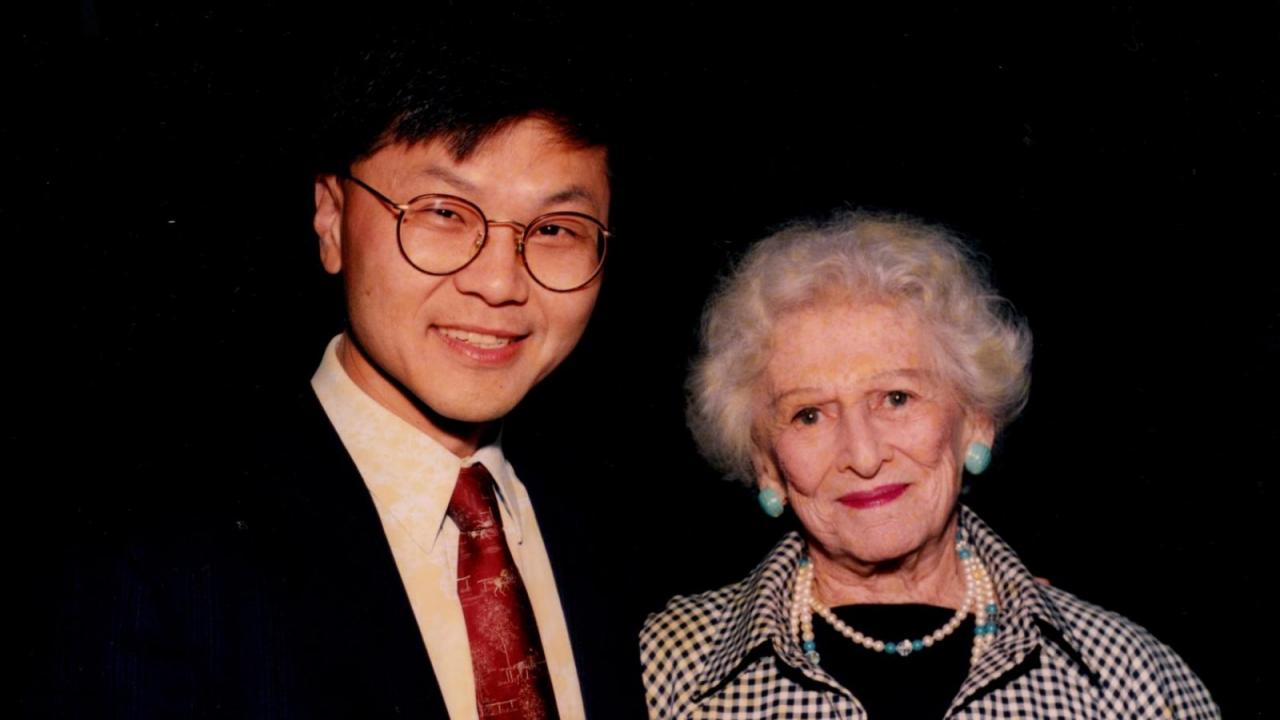
She recruited Dr. David Ho, a 38-year-old research biologist on
the faculty of the UCLA School of Medicine, as the founding director,
after his work in drug-resistant strains of the AIDS virus caught
her attention.
"Irene wanted a great research institute in New York, the epicenter
of the AIDS epidemic in this country," Ho told The Times. "She
was a maverick, she chose me despite my young age. She was focused
on the younger generations."
Five years after he was appointed, Ho was named Time magazine's
Man of the Year. He and his colleagues had discovered a new strategy
to flush out the virus that causes AIDS.
Ho and Diamond became close friends. He often dined at her sprawling,
informal Park Avenue apartment. The diminutive hostess, who was
hardly more than 5 feet tall and who preferred to cut her own hair
at home rather than waste time in a beauty parlor, served "a
simple, good meal," Ho said. Afterward, they talked for six
or seven hours, with Ho doing most of the listening about everything
from medical research and gun control to ballet and classical music.
Medical science and minority education each accounted for 40% of
the Diamond endowment program. The other 20% went to the arts. Two
years before the Aaron Diamond Foundation was spent in 1996, Irene
Diamond launched her own charitable trust, the Irene Diamond Fund,
with no time limit attached. She made slight adjustments in the
original foundation's program by expanding her priorities to include
human rights projects.
In recent years the Juilliard School's minority scholarship program,
the Dance Theater of Harlem and the Human Rights Watch have received
multimillion-dollar grants.
"The arts were part of Irene's life: She saw how they helped
explain the human experience," said Joseph W. Polisi, director
of the Juilliard School in New York City, which received $10 million
from the Diamond foundation in 1992. The money helped build the
enrollment of African American, Latino and Native American students
at the school.
As a young girl in Pittsburgh, Irene Levine's Russian-immigrant
parents provided piano lessons for her. But she dreamed of becoming
an actress. After high school, in the early 1920s, she moved to
New York City, changed her name to Irene Lee and studied repertory
theater.
In 1933 she was invited to Hollywood for a screen test but changed
careers after she met producer Hal Wallis, who offered her a job
as a story editor.
"I lived and breathed writing," Diamond said of those
years. She found scripts and plays that Wallis could adapt for the
screen. Among her discoveries was the play that later became the
movie "Casablanca."
The version she read, "Everybody Comes to Rick's," was
an unproduced play with several rejection slips attached to it.
Wallis paid $20,000 for it. Diamond later complained that Wallis
never gave her credit for her part in the deal.
In the book "Round Up the Usual Suspects" (1992), which
was about the making of "Casablanca," author Aljean Harmentz
quoted Julius Epstein, one of the scriptwriters. "Irene Lee
deserves the credit," he said about the discovery of the play.
"She was much smarter than Hal Wallis. She was the one who
assigned us to write it."
Despite the rift, Diamond worked with Wallis until he closed his
office in 1970.
In 1942 she married Aaron Diamond and they had one daughter, Jane,
in 1944. Irene continued to work for Hollywood from New York. Over
the years she purchased more than 30 scripts. Several became movie
classics.
Diamond became sensitive to human rights issues during the McCarthy
era of the 1950s, when a number of her Hollywood friends were accused
of being Communists. She too was subpoenaed by the House Un-American
Activities Committee to testify on whether Hollywood producers were
putting Communist propaganda on the screen. "It was the height
of McCarthyism -- such a time of fear and intimidation and censorship,"
she said later.
She went to Washington, but spent the day waiting in the hall outside
the hearing room. She was never called to testify.
In 1988, after 15 years on the board of Human Rights Watch, Diamond
pledged $30 million to the organization, at $2 million per year
for 15 years. At the time, the group's annual budget was about one-tenth
that amount.
"Irene made it possible for Human Rights Watch to go from a
group of concerned volunteer citizens to an institution," said
the group's director of communications, Carroll Bogert. The group
attracted Diamond's attention in the early 1980s when it challenged
President Ronald Reagan's claims that U.S. allies in El Salvador
and Nicaragua were not violating human rights.
"Irene Diamond liked that we were such high-profile critics,"
Bogert said.
Diamond received honorary degrees from at least five major colleges
and universities, including Rockefeller University and the Juilliard
School. Her awards included one for leadership in the arts, awarded
by President Bill Clinton in 1999.
Diamond is survived by her daughter and two grandchildren.
|